PRACTICAL GUIDE
How to use a tyre inflator safely
Find your vehicle’s recommended cold pressure, select the correct unit, connect the inflator securely and check the finished reading. Always follow the exact vehicle and pump instructions for power supply and operating time.

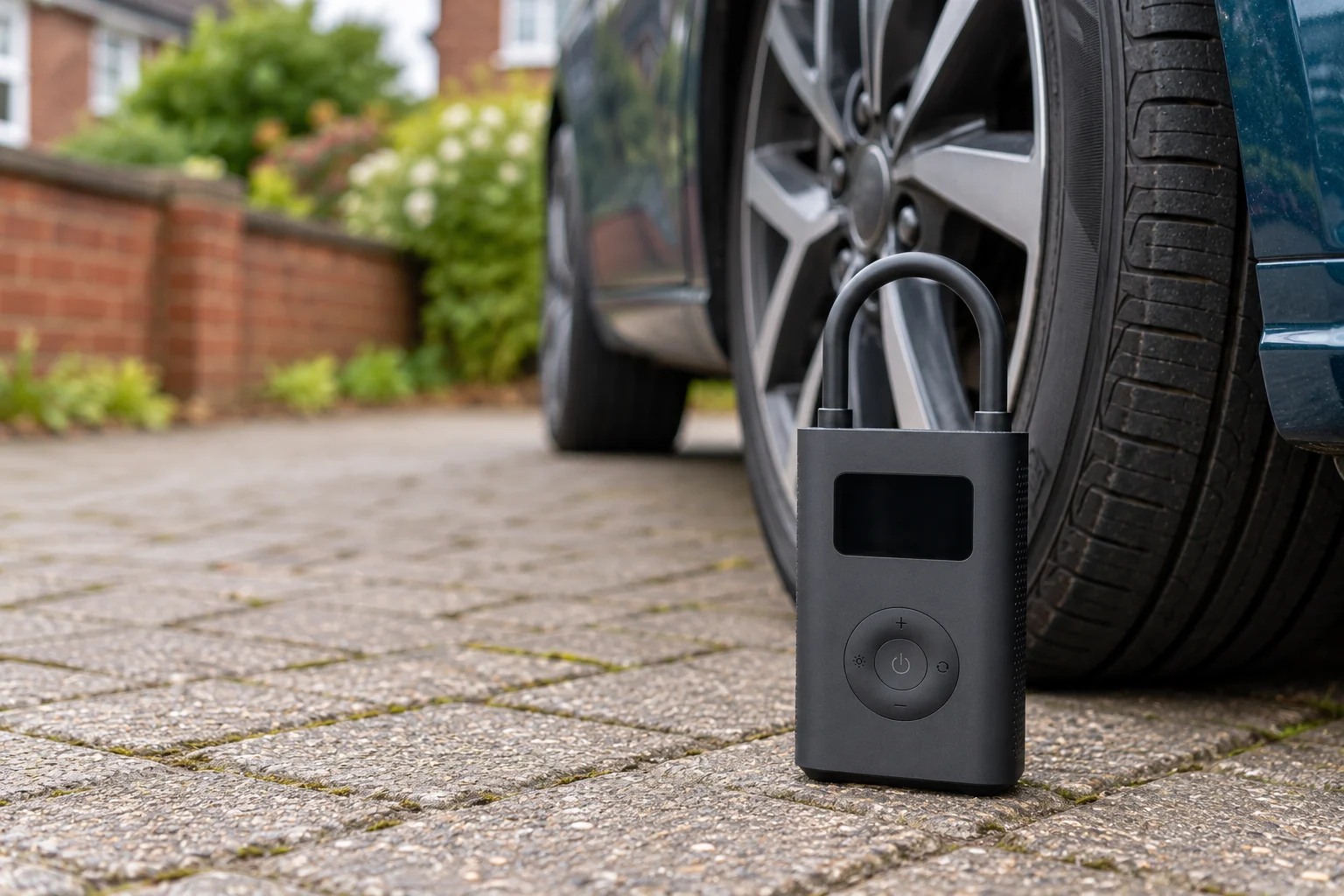
Before you press start
- Target pressure: use the vehicle placard or handbook, including the correct load setting.
- Correct unit: PSI, bar and kPa are different scales for the same pressure.
- Suitable power: confirm socket capacity or sufficient battery charge.
- Secure connector: use the correct valve adaptor without straining the hose.
- Operating limit: read the exact model’s running and cooling instructions.
Inflating a car tyre, step by step
Find the recommended cold pressure
Check the handbook or pressure placard, often in a door opening or fuel flap. Front and rear settings may differ, and heavier loads may need different pressures. The tyre sidewall’s maximum is not the everyday vehicle recommendation.
Check before driving
Prefer cold tyres. Inspect for visible damage and do not treat inflation as proof that a damaged or previously run-flat tyre is safe. Park securely in a safe place.
Prepare the inflator
Read its manual, select the correct units and connect the approved power source. Do not assume a “car” preset is correct for your car.
Attach the hose
Remove and keep the valve cap. Connect the hose securely and support the unit so its weight does not strain the valve. Persistent hissing suggests a connection that needs checking.
Set the target and monitor
Add air towards the specified pressure. Automatic shut-off is convenient, but stay with the pump and respect running/rest limits. Stop if the equipment behaves abnormally.
Verify and finish
Check the finished pressure with a reliable gauge. Disconnect, replace the valve cap, repeat for the other tyres and allow hot parts to cool before packing away.
If something is not working
| Symptom | What to check |
|---|---|
| No power | Check the approved power source, battery charge, connections and the manuals. Never substitute a higher-rated fuse. |
| Air escapes at the valve | Stop and check the connector, adaptor and valve condition. Avoid overtightening. |
| Inflation seems slow | Check the tyre size, pressure difference, supply and operating limits. Maximum PSI does not predict speed. |
| The pressure drops again | Have the tyre, valve and wheel checked by a tyre specialist. Repeated topping up does not fix a leak. |
What if the tyres are warm?
Tyre pressure normally rises as tyres warm during driving. Do not release air simply to bring a warm tyre down to its cold-pressure setting. Prefer a cold recheck and follow your vehicle and tyre guidance.
Build a simple checking routine
TyreSafe advises checking at least monthly and before long journeys. TPMS is useful, but it does not replace regular pressure and condition checks. Include the spare if your vehicle carries one, using its specified pressure.
Use our PSI, bar and kPa converter if the pump and placard use different units.
Frequently asked questions
Can I leave an auto-stop inflator unattended?
Stay with the pump. Automatic shut-off does not replace monitoring, a secure connection or compliance with operating limits.
Does the engine need to be on?
Follow the vehicle and inflator manuals. Requirements differ; do not run an engine in an enclosed space.
Can an inflator fix a puncture?
Adding air does not repair a puncture. Follow your vehicle’s emergency procedure and get professional advice, especially after driving on a flat tyre.
Sources & further reading
- TyreSafe — finding vehicle pressure settings ↗
- TyreSafe — pressure-check frequency and TPMS ↗
- Michelin — inflating tyres ↗
Editorial review: 13 October 2026. Manufacturer claims remain attributed; specifications can change.