PRACTICAL GUIDE
Cordless vs 12V tyre inflators: which should you choose?
Choose a cordless inflator for freedom to move, or a 12V model to avoid maintaining a separate pump battery. Your vehicle supply, charging habits, tyre workload and complete kit cost matter more than a blanket claim that one type is better.

The practical differences
| Consideration | Cordless | 12V socket |
|---|---|---|
| Power | Integrated or removable rechargeable battery | Compatible vehicle supply |
| Reach | No cable back to the car; air hose still matters | Limited by cable route and air hose |
| Readiness | Requires a charging routine | No separate inflator battery; vehicle supply must be suitable |
| Cost | Some tool models exclude battery and charger | Check included adaptors and exact kit |
| Performance | Must be established for the model and task | Must be established for the model and task |
Choose for the way you will use it
| Situation | Starting point | Check first |
|---|---|---|
| Car and bicycle top-ups | Compact rechargeable | Valve adaptors, hose access and charge maintenance |
| Pump kept with one car | 12V socket model | Socket capacity, cable reach and permitted operation |
| Existing tool-battery household | Compatible tool-platform inflator | Exact pack compatibility and total kit cost |
| Larger tyres or repeated use | A model selected for the workload | Pressure, air volume, duty limits and credible test evidence |
Three different approaches
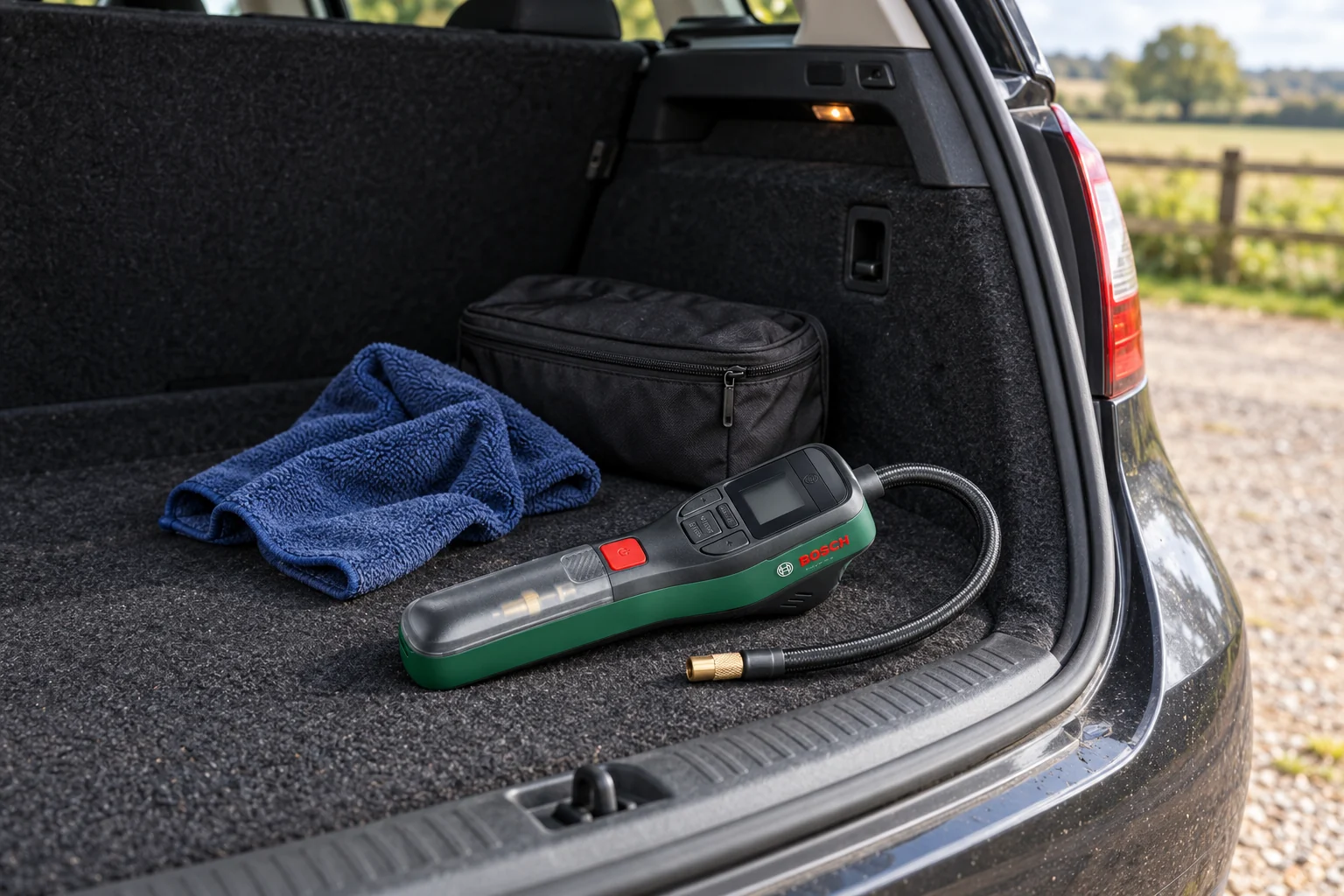
The Ring ULTRAINFLATE 20 assessment uses a 12V supply, 3 m cable and 60 cm hose. The Bosch EasyPump assessment has a built-in 3.6V battery and 20 cm hose. The DeWalt DCC018N-XJ assessment supports both a compatible 18V XR pack and an included 12V car adaptor. Power categories are therefore not always mutually exclusive.
Which is faster?
The power-source label does not answer this. Compare tests using the same tyre, starting pressure, target pressure and supply conditions. Battery state, temperature and pauses for cooling can affect the job. We have not carried out a controlled cordless-versus-12V test, so we do not manufacture a speed ranking.
The ownership check that matters
Imagine your next pressure check. Can you place the pump without hanging it from the valve? Can the cable reach the last wheel? Will you remember to charge it? If you need an extra battery, charger or mains adaptor, what does the complete setup cost? Answering these questions is more useful than choosing by maximum PSI alone.
Find the right shortlist
Compare cordless tyre inflators for self-contained and tool-battery options. Compare 12V inflators for vehicle-powered choices. For larger vehicles, read our workload and heavy-duty buying guide.
Frequently asked questions
Is a cordless tyre inflator worth it?
It can be worthwhile when freedom of movement and mixed car-and-bike use matter, provided you maintain its charge. Check the exact model’s operating limits.
Can a pump use both battery and 12V power?
Yes. The UK DeWalt DCC018N-XJ supports a compatible 18V XR battery and an included 12V car adaptor. The battery is separate in the tool-only package.
Sources & further reading
- Ring ULTRAINFLATE 20 — UK manufacturer specifications ↗
- Bosch EasyPump — UK manufacturer specifications ↗
- DeWalt DCC018N-XJ — UK specification and included accessories ↗
Editorial review: 13 October 2026. Manufacturer claims remain attributed; specifications can change.